Download reports, tool-kits, and explore useful links that support our mission.
Access our reports, tool-kits, and publications to learn more about our work.
Comprehensive overview of our achievements, impact metrics, and financial statements for the year 2024.
Download PDFPractical guide for communities on sustainable forest management and agroforestry practices.
Download PDFIndependent evaluation of our One-Village-One-Forest initiative's effectiveness and outcomes.
Download PDFBest practices and protocols from our MAM/SAM/IMAM nutrition programs in partnership with UNICEF.
Download PDFFind answers to common questions about our work and how you can get involved.
We welcome volunteers with various skills. Please visit our Get Involved page and fill out the volunteer application form. We'll match your skills with our current needs in Sierra Leone.
SHADE primarily operates in Karene District and the Outamba-Kilimi region, working with over 25 communities across 10 chiefdoms. We focus on areas most vulnerable to climate change and economic hardship.
85% of donations go directly to our programs in Sierra Leone, including community forestry, women's livelihoods, nutrition programs, and education. 15% covers administrative and operational costs to ensure program sustainability.
Yes! We actively seek partnerships with organizations that share our mission. Please contact us through our Partners page with your proposal, and our team will respond within 5 business days.
Real impact from our programs in Sierra Leone communities.
SHADE is currently funded through a five years' Trocaire/Irish Aid Civil Society Programme to strengthen and enhance the technical, food security, socio-economic well-being of people living in this deprived, marginalized and completely isolated chiefdom in Sierra Leone. The aim of the project is to strengthen community resilience to climate risks and be better positioned to adapt and mitigate adverse climatic variabilities.
Objectives include:
Name: Madam Mabinty Sesay - Chairlady, Household Loan and Saving Scheme
Age: 53 | Sex: Female
Location: Fintonia, Tambaka Yobayie Chiefdom
Tambaka chiefdom is not only isolated from the rest of Sierra Leone with a difficult ferry crossing that is often grounded for over four months during the raining season, the people are also financially disconnected from all financial services provided by the government, development partners and private entities.
Tambaka chiefdom has no commercial or community bank where people can save their hard earned money to avoid being stolen. Women in this chiefdom are often the bread winners, farmers, traders and caretakers of their family. Prior to the intervention, Village Loan and Saving groups were managed by literate people using only exercise books without any membership cards or key distribution system to reduce corruption and ensure transparency.
In 2023, SHADE introduced Household Loans and Saving Scheme (HoLSS), different from traditional Village Savings and Loan Associations. The scheme includes:
I am Madam Mabinty Sesay, the chairlady of Fintonia community, a house wife with five children, the only breadwinner of my family and a member of the Household Loan and Saving Scheme. I have joined many Village Savings and Loan Associations in this village where I was born and got married but with little impact. However, this particular scheme introduced by SHADE through Trocaire/Irish Aid support looks unique and special. The transparency and inclusivity looks interesting.
With the sum of SLe5,000 loaned, I was able to pay my last child's second semester college fees, buy a bag of rice during the hunger period (raining season) and used the rest of the money to invest in the soil. By investing in the soil using the loan, I was able to harvest 10 bags of pepper which was sold at SLe1,200 per bag. With the SLe10,200 earned from the soil, I was able to pay the loan and currently feeding my family.
Additional Impact:
This was what Isata L. Kamara had to say: 'My husband and I used to quarrel over food for the home, welfare and education of the kids and his desire to marry another woman. With this scheme, the loan I received and the education provided during our meetings, I have overcome this jealousy and I am now supporting the home and doing my vegetable gardening which has increased my earning. I have realized that my husband no longer talks about marrying another woman and we are now living in a peaceful atmosphere.'
The proposed next steps include:
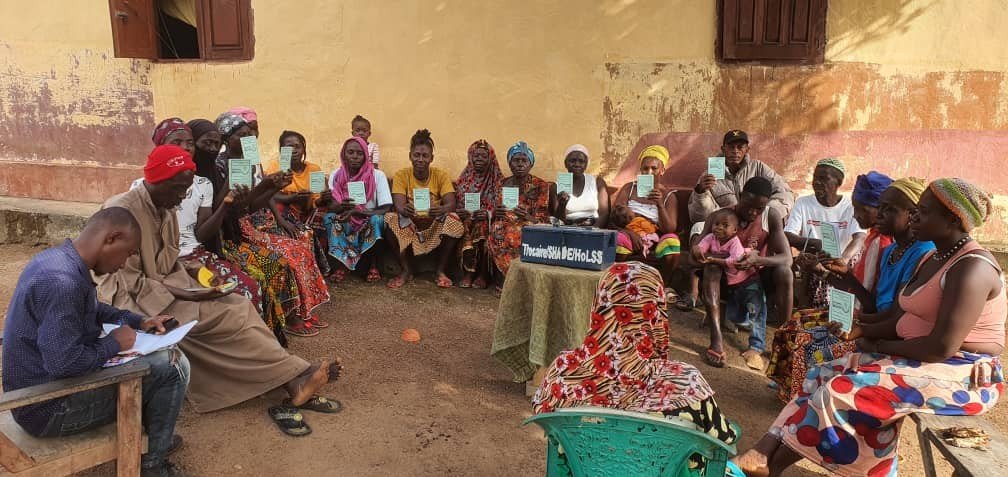
Meeting of the Household Saving Scheme each showing their membership cards
Your donation helps us expand programs like the Household Loan and Savings Scheme to more communities across Sierra Leone, empowering women and building climate resilience.